In honor of prospie weekend. I don't believe I have any high school aged readers, but I implore my readers to please send this to any high school students they know; these are the facts the brochures will not tell them, because college brochures are universally useless.
1. That feeling when you bump into someone, and neither of you is at fault, or both of you are, and the two of you apologize in the same breath, as though you're both speaking with one voice. You'll never feel as connected to anyone as you do in those moments.
2. The immense tenderness you feel when you see someone in the dining hall reading a book you love, and say nothing.
3. The camaraderie of the midnight fire alarm, especially in the winter. No one's actually frightened, because everyone knows that all that's actually happened is that a freshman has tried to make popcorn, but everyone is underdressed, and everyone is either furious or resigned. Someone was in the shower, and everyone else is telling the story of the time that one time alarm went off when they were in the shower. There really is true camaraderie in that: solamen miseris socios habuisse doloris, to coin a phrase.
4. The communal joy of the first really warm day—not the first day without coats, I mean the first day when nobody's even wearing sweaters, and you're so thrilled at the sight of strangers' bare arms—people have arms! you'd forgotten!—that you think, Is this what it was like to be Walt Whitman? The answer is yes.
5. One time last semester I was walking to my 8:30 in the rain and an elderly education professor I'd never met shared his umbrella with me, and it was kind of wonderful? I'm not sure how universal this one is, but it was really nice. What a great guy.
6. Night class.
7. Eight AM Greek reading class.
8. It is genuinely possible to experience a great deal of true comradeship working in theatre, but I'm not gonna talk about it. If you've experienced it you know what I'm talking about and if you haven't any description will be obnoxious to you, because theatre people are never more obnoxious than when they're trying to tell you their feelings about the theatre. The thing about artists, right, is that we all believe the medium we work in is the highest form of human creativity, and the thing that makes theatre people different from the rest of us is that they don't bother pretending otherwise. They're not really that much more up themselves than normal artists, but they're infinitely more upfront about it. (I'm... kind of a theatre person? It's Schrödinger-y.)
That is all; those are all the times you will feel human connection in university. You will also read some really good books.
Showing posts with label the College Experience. Show all posts
Showing posts with label the College Experience. Show all posts
26 March 2017

8 October 2016
september bookblogging.
[disclaimer: I wrote most of this instead of reading Wallace Stevens in preparation for my English midterm. If it's only half as disjointed as "Notes Toward a Supreme Fiction" it... should still be pretty incomprehensible, actually.]
I'd assumed that being at school would bring my book count significantly down, but the damage isn't as bad as I'd feared; I managed ten this month besides school books, and two of them were really quite long.
Jill Lepore, Joe Gould's Teeth. This book is so good; I think it's the only biography I've ever read that's gripped me like a novel. Joe Gould was for a while very famous, mostly because he had famous friends—he got check-ups from William Carlos Williams! Alice Neel painted him! he was friends with Ezra Pound and E.E. Cummings! (Gould and Pound bonded over how much they both hated Jewish people, this is literally a true fact, I hate Ezra Pound with the fire of a thousand suns.) Nowadays almost no one has heard of him, which is a shame. He got into Harvard as a legacy student, dropped out of Harvard, worked briefly for a eugenicist organization, was often homeless and at least once institutionalized, and he also invented oral history. Lepore's book is about all this, and it's also about Augusta Savage, a black sculptor Joe Gould harassed for years. Sad, weird, highly recommended.
Patience Agbabi, Telling Tales. A contemporary verse retelling of the Canterbury Tales. I mentioned this on the blog back when I first found out about it, and almost as soon as I moved back to Wheaton I ordered an ILL of it. It's just as good as I was hoping it might be. Clever, funny, experimental, true to the source material, and she made the Miller's Tale even more bawdy. (I know! I was astonished too!) There's no real dead wood here, even the Tale of Melibee is surprising, but my very favorites were "Joined-Up Writing" (a sonnet cycle based on the Man of Law's Tale) and "The Contract" (the Second Nun's Tale, as narrated by one of the assassins who killed Cecilia).
 Pamela Dean, Tam Lin. A re-read. This is a college novel about fairies. It was one of my favorite books in high school, and one of the few books I brought with me to university, but I was nervous about reading it again as an actual college student myself. I finally reread it on Labor Day, when I was recovering from a ghastly cold and needed to read something engaging but not actually taxing. To my delight, it held up and had even improved. Several of the characters are classics majors (in that sense it's really sort of a lighter-and-softer counterpart to The Secret History) and those parts were even better now that I student ancient Greek myself. I love this book.
Susan Palwick, Shelter. Why does no one ever talk about Susan Palwick? How does Susan Palwick not have a Hugo? This is near-future science fiction about AI and parenthood and mental illness. It's not one of those one-big-change books, it's subtle and complex and there's a lot going on in it. Palwick gets a lot of things right that writers, and sci-fi writers in particular, usually get wrong—she writes wonderfully about religion for one thing, and for another she can write believable children. Nick isn't a normal child, or a healthy one, but he's as desperately real as the adult characters are. Absorbing, stunning, you need to read it now.
Lindy West, Shrill: Notes from a Loud Woman. A feminist memoir. It's good, funny and angry and well-written, but I'm not sure it's quite as good as it's been made out to be. This may be partly because I'd already heard some of the best bits on a recent episode of This American Life. Caitlin Moran on the back cover is particularly egregious in saying that it's "literally the new Bible." Right. And Jessica Valenti's memoir is literally the Bhagavad Gita, and Bad Feminist is literally the Enuma Elish, and words literally mean nothing. Come on, Caitlin.
Lucy Knisley, Something New. Another memoir, this one a comic about Knisley's wedding. Fun, but slight and overlong. I might write something longer about it; watch this space.
Michel Faber, The Book of Strange New Things. Peter Leigh is a priest (n.b. the book does not use the word priest and I think that might be significant), Anglican-not-otherwise-specified, who gets sent to a recently-colonized planet to act as a missionary to the native population. This was a disappointment. It's a long book, and a lot of it is spent inside Peter's head, or in his emails home to his wife, and that's a problem given that Peter is neither likable nor interesting; at the end of the book I felt I didn't know much about him and didn't care to know more. (Note: based on plot developments, this is possibly something Faber's doing intentionally. It didn't work for me.) Theological science fiction is my entire jam, and I'll read as many examples as the industry produces, but this book is not great. The theology's nothing to write home about either, and much of the writing about Peter's faith felt fairly shallow to me. Just read The Sparrow instead.
Suzette Haden Elgin, Native Tongue. A classic of feminist sci-fi. How much you enjoy this book will depend on your tolerance for second-wavers and the strong Sapir-Whorf hypothesis. I can cope with both of those things in a controlled environment, so I thought it was pretty awesome. A lot of the thought here falls apart fairly quickly if you start picking at it even a little bit (a text message I sent to my mother halfway through: "I reject the essentialist notion of a single 'female experience' in any kind of universalized sense"), but if you're into this sort of thing it's worth your time. I like it better than The Handmaid's Tale, to which it is usually compared, because Elgin writes female friendship better and is less afraid of science fiction cooties.
Susan Palwick, The Necessary Beggar. Absolutely wonderful. When Darroti kills a woman, he and his family are exiled to another dimension. They come through in a refugee camp in Nevada, where they start a long slow process of learning to live in another world. This book is about home and family and grief, and it's both sad and hopeful. Palwick does a gorgeous job of building her fantasy world, and of writing the culture shock that comes with the move to ours. (Content warning for suicide.)
Patrice Kindl, Owl in Love. This won the Mythopoeic Award for Children's Lit in 1995, and it unquestionably deserved it; this is what YA was made to do, and I've never read anything like it. Owl is a fourteen-year-old in love with her science teacher, and being a were-owl doesn't help. The first-person narration is both completely realistic and utterly alien: Owl is cold, uncertain, overconfident, passionate, awkward, brilliant, and totally sui generis.
Rebekah Nathan, My Freshman Year. This was for my Intro to Anthropology class. An anthropology professor in her fifties enrolls in her university as a freshman so she can understand the undergraduate experience, comes away with astonishing insights like "sometimes students don't do all their assigned reading." I too was stunned!
&
So that's eleven in total, ten of them by women. Four nonfiction, one comic, one book of poetry. All of them were library books except for Tam Lin and My Freshman Year, which I own. (Well, Freshman is a rental.) My favorite was either Owl in Love or one of the Palwick books, and I'll definitely be seeking out more by both Palwick and Kindl. I'll see you next month with another haul!
I'd assumed that being at school would bring my book count significantly down, but the damage isn't as bad as I'd feared; I managed ten this month besides school books, and two of them were really quite long.
Jill Lepore, Joe Gould's Teeth. This book is so good; I think it's the only biography I've ever read that's gripped me like a novel. Joe Gould was for a while very famous, mostly because he had famous friends—he got check-ups from William Carlos Williams! Alice Neel painted him! he was friends with Ezra Pound and E.E. Cummings! (Gould and Pound bonded over how much they both hated Jewish people, this is literally a true fact, I hate Ezra Pound with the fire of a thousand suns.) Nowadays almost no one has heard of him, which is a shame. He got into Harvard as a legacy student, dropped out of Harvard, worked briefly for a eugenicist organization, was often homeless and at least once institutionalized, and he also invented oral history. Lepore's book is about all this, and it's also about Augusta Savage, a black sculptor Joe Gould harassed for years. Sad, weird, highly recommended.
Patience Agbabi, Telling Tales. A contemporary verse retelling of the Canterbury Tales. I mentioned this on the blog back when I first found out about it, and almost as soon as I moved back to Wheaton I ordered an ILL of it. It's just as good as I was hoping it might be. Clever, funny, experimental, true to the source material, and she made the Miller's Tale even more bawdy. (I know! I was astonished too!) There's no real dead wood here, even the Tale of Melibee is surprising, but my very favorites were "Joined-Up Writing" (a sonnet cycle based on the Man of Law's Tale) and "The Contract" (the Second Nun's Tale, as narrated by one of the assassins who killed Cecilia).
 Pamela Dean, Tam Lin. A re-read. This is a college novel about fairies. It was one of my favorite books in high school, and one of the few books I brought with me to university, but I was nervous about reading it again as an actual college student myself. I finally reread it on Labor Day, when I was recovering from a ghastly cold and needed to read something engaging but not actually taxing. To my delight, it held up and had even improved. Several of the characters are classics majors (in that sense it's really sort of a lighter-and-softer counterpart to The Secret History) and those parts were even better now that I student ancient Greek myself. I love this book.
Susan Palwick, Shelter. Why does no one ever talk about Susan Palwick? How does Susan Palwick not have a Hugo? This is near-future science fiction about AI and parenthood and mental illness. It's not one of those one-big-change books, it's subtle and complex and there's a lot going on in it. Palwick gets a lot of things right that writers, and sci-fi writers in particular, usually get wrong—she writes wonderfully about religion for one thing, and for another she can write believable children. Nick isn't a normal child, or a healthy one, but he's as desperately real as the adult characters are. Absorbing, stunning, you need to read it now.
Lindy West, Shrill: Notes from a Loud Woman. A feminist memoir. It's good, funny and angry and well-written, but I'm not sure it's quite as good as it's been made out to be. This may be partly because I'd already heard some of the best bits on a recent episode of This American Life. Caitlin Moran on the back cover is particularly egregious in saying that it's "literally the new Bible." Right. And Jessica Valenti's memoir is literally the Bhagavad Gita, and Bad Feminist is literally the Enuma Elish, and words literally mean nothing. Come on, Caitlin.
Lucy Knisley, Something New. Another memoir, this one a comic about Knisley's wedding. Fun, but slight and overlong. I might write something longer about it; watch this space.
Michel Faber, The Book of Strange New Things. Peter Leigh is a priest (n.b. the book does not use the word priest and I think that might be significant), Anglican-not-otherwise-specified, who gets sent to a recently-colonized planet to act as a missionary to the native population. This was a disappointment. It's a long book, and a lot of it is spent inside Peter's head, or in his emails home to his wife, and that's a problem given that Peter is neither likable nor interesting; at the end of the book I felt I didn't know much about him and didn't care to know more. (Note: based on plot developments, this is possibly something Faber's doing intentionally. It didn't work for me.) Theological science fiction is my entire jam, and I'll read as many examples as the industry produces, but this book is not great. The theology's nothing to write home about either, and much of the writing about Peter's faith felt fairly shallow to me. Just read The Sparrow instead.
Suzette Haden Elgin, Native Tongue. A classic of feminist sci-fi. How much you enjoy this book will depend on your tolerance for second-wavers and the strong Sapir-Whorf hypothesis. I can cope with both of those things in a controlled environment, so I thought it was pretty awesome. A lot of the thought here falls apart fairly quickly if you start picking at it even a little bit (a text message I sent to my mother halfway through: "I reject the essentialist notion of a single 'female experience' in any kind of universalized sense"), but if you're into this sort of thing it's worth your time. I like it better than The Handmaid's Tale, to which it is usually compared, because Elgin writes female friendship better and is less afraid of science fiction cooties.
Susan Palwick, The Necessary Beggar. Absolutely wonderful. When Darroti kills a woman, he and his family are exiled to another dimension. They come through in a refugee camp in Nevada, where they start a long slow process of learning to live in another world. This book is about home and family and grief, and it's both sad and hopeful. Palwick does a gorgeous job of building her fantasy world, and of writing the culture shock that comes with the move to ours. (Content warning for suicide.)
Patrice Kindl, Owl in Love. This won the Mythopoeic Award for Children's Lit in 1995, and it unquestionably deserved it; this is what YA was made to do, and I've never read anything like it. Owl is a fourteen-year-old in love with her science teacher, and being a were-owl doesn't help. The first-person narration is both completely realistic and utterly alien: Owl is cold, uncertain, overconfident, passionate, awkward, brilliant, and totally sui generis.
Rebekah Nathan, My Freshman Year. This was for my Intro to Anthropology class. An anthropology professor in her fifties enrolls in her university as a freshman so she can understand the undergraduate experience, comes away with astonishing insights like "sometimes students don't do all their assigned reading." I too was stunned!
&
So that's eleven in total, ten of them by women. Four nonfiction, one comic, one book of poetry. All of them were library books except for Tam Lin and My Freshman Year, which I own. (Well, Freshman is a rental.) My favorite was either Owl in Love or one of the Palwick books, and I'll definitely be seeking out more by both Palwick and Kindl. I'll see you next month with another haul!
26 August 2016
poetry friday: wordsworth, sayers, & me.
The sonnet is beyond doubt my favorite poetic form; one of my more questionable skills is the ability to instantly identify fourteen-line blocks of text even in free verse, prose, and internet comments. Moving into my dorm this week, I was reminded of one of my very favorite sonnets, Wordsworth's "Nuns Fret Not at Their Convent's Narrow Room."
Thinking about these two Petrarchan sonnets, I wrote my own. I have perhaps prejudiced you against it by prefacing it with the works of two far superior sonneteers. Nevertheless, I'm pleased with it, and I enjoyed making it. It's about my freshman year at Wheaton, and about the consolations of study.
It's only now that I have the perspective I need to write the above sonnet, and that's reflected in the fact that moving in this year has been incalculably easier than last year. I'm feeling a confidence and peace that would have been almost incomprehensible to me this time last year. Indeed the sheer number of conversations I've had today would have seemed absurd to me: a friend I ran into in the dining hall at breakfast, a professor from last year who told me I should drop by and talk to her, another friend on the way to lunch who proclaimed himself a faithful follower of this blog (hi)—and others. My sonnet's most grievous omission, which I can only explain with the phrase "scanty plot of ground," is that I've left out all my wonderful living friends and teachers. Fourteen lines, remember, and if there is one certainty in this life it is that there will always (always, always) be more poems.
Less importantly, I'm slightly troubled by the implication that we studied Wordsworth in my English classes last year; we did not, but I'm fond enough of the wording that I'm keeping it as it is.
I'm happy; I wasn't sure I would be, but I am. I'm writing a lot. It's good.
The roundup is here.
Nuns fret not at their convent's narrow room;It's beautiful. On the most literal level I love it because I've always liked small rooms, enclosed spaces, a quiet place to focus on my work. I love it too as a defense of the sonnet (a Petrarchan sonnet at that, which in English is far more difficult than the Shakespearean sonnet), with all its constraint and freedom. And on this reading it reminded me of another sonnet about the contemplative life, Dorothy Sayers' from Gaudy Night. Within the novel Harriet Vane writes the first eight lines and then accidentally puts them in a bundle of papers that she gives to her suitor/detective partner Peter Wimsey. When she gets it back, he's completed her poem with a sestet.
And hermits are contented with their cells;
And students with their pensive citadels;
Maids at the wheel, the weaver at his loom,
Sit blithe and happy; bees that soar for bloom
High as the highest Peak of Furness-fells,
Will murmur by the hour in foxglove bells:
In truth the prison, into which we doom
Ourselves, no prison is: and hence for me,
In sundry moods, 'twas pastime to be bound
Within the Sonnet's scanty plot of ground;
Pleased if some Souls (for such there needs must be)
Who have felt the weight of too much liberty,
Should find brief solace there, as I have found.
Here then at home, by no more storms distrest,It's a gorgeous and terrifying tension, inaction as rest versus inaction as death, and it encapsulates the central tension of the novel, Harriet's internal battle over whether it's possible for an educated woman to have both a life of the mind and a life of the heart, whether Harriet herself can have her career as a novelist and love Peter. "What," in Harriet's words, "are you to do with the people who are cursed with both hearts and brains?" In Peter's sestet he offers her a picture of the dangers of contemplation, the idea that being still and contemplative, "poised on the perilous point," is acceptable only so long as we are kept upright by the whips of love. It's love, of course, that keeps us alive; it always was.
Folding laborious hands we sit, wings furled;
Here in close perfume lies the rose-leaf curled,
Here the sun stands and knows not east nor west,
Here no tide runs; we have come, last and best,
From the wide zone in dizzying circles hurled
To that still centre where the spinning world
Sleeps on its axis, to the heart of rest.
Lay on thy whips, O Love, that me upright,
Poised on the perilous point, in no lax bed
May sleep, as tension at the verberant core
Of music sleeps; for, if thou spare to smite,
Staggering, we stoop, stopping, fall dumb and dead,
And, dying so, sleep our sweet sleep no more.
Thinking about these two Petrarchan sonnets, I wrote my own. I have perhaps prejudiced you against it by prefacing it with the works of two far superior sonneteers. Nevertheless, I'm pleased with it, and I enjoyed making it. It's about my freshman year at Wheaton, and about the consolations of study.
It wasn't quite a pensive citadel,It's a poem for last year, inspired largely by observing the new freshmen, and I suppose this time next year you can expect a poem about sophomore year. Poems take time, even when you're not actively writing them; this morning in my English class I learned that the two-line "In a Station of the Metro" took Actual Fascist Ezra Pound a year and a half to write after the experience it describes, and all that time he was thinking how best to put it into words. (His first draft was thirty lines long.) "Emily Dickinson could have done it overnight," my professor said, "but most of us need time for our ideas to distill and ferment." (A paraphrase based on my notes, but she really did say that about Dickinson and it really is true; in 1862 she wrote 366 poems.)
Those four white walls I shared with stranger soul.
I felt condemned to play a foreign role
And longed for peace, a silent monkish cell.
That was a loneliness I could not quell
When I was young and scared and far from whole.
And being far from home took its sure toll:
It was in exile Dante wrote his Hell.
But I was saved by friendship with the dead.
In their words comfort came and strength anew.
In study found I gifts from God above:
In Homer's wars, in Chaucer's pilgrim tread,
In thought, in word, in quest for something true,
In fourteen lines that sang an ancient love.
It's only now that I have the perspective I need to write the above sonnet, and that's reflected in the fact that moving in this year has been incalculably easier than last year. I'm feeling a confidence and peace that would have been almost incomprehensible to me this time last year. Indeed the sheer number of conversations I've had today would have seemed absurd to me: a friend I ran into in the dining hall at breakfast, a professor from last year who told me I should drop by and talk to her, another friend on the way to lunch who proclaimed himself a faithful follower of this blog (hi)—and others. My sonnet's most grievous omission, which I can only explain with the phrase "scanty plot of ground," is that I've left out all my wonderful living friends and teachers. Fourteen lines, remember, and if there is one certainty in this life it is that there will always (always, always) be more poems.
Less importantly, I'm slightly troubled by the implication that we studied Wordsworth in my English classes last year; we did not, but I'm fond enough of the wording that I'm keeping it as it is.
I'm happy; I wasn't sure I would be, but I am. I'm writing a lot. It's good.
 |
| My building, feat. trees, fountain, and a bit of lamp post. |
 | ||
| This is most of what I do in my dorm. |
12 July 2016
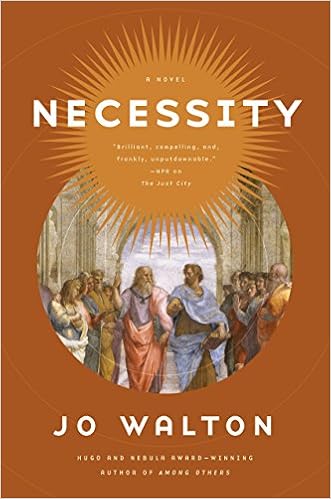
book review: necessity, jo walton.
 |
| Image from Amazon. |
Jo Walton is one of those few living writers whose new books I am always willing to buy sight-unseen. Connie Willis is another such (have you seen she has a novel out in September?); Terry Pratchett, while he lived, was another. The first book of Walton's that I read was Among Others, which was a birthday present the summer I turned fifteen. I remember beginning to read it on a fold-out couch in my grand-parents' house. When I came to the line in the preface where she says "there was never such a year as 1979, no such age as fifteen, and no such planet as Earth. The fairies are real, though" I began to cry so I thought I'd never stop. I couldn't quite articulate why then, and I can't now. All I know really is that fifteen was a difficult year, and Among Others was just the kind of book I needed to help me get through it in one piece, the kind of book that felt as though it had been written specially for me. It's still one of my very favorites, and I've re-read it several times since then though I try not to read it too often for fear it'll lose some of its magic.
I think the next one I read was Tooth and Claw, the one about Trollope's dragons. Even my mother liked it, and I think they may be the only dragons she's ever cared about besides Eustace. (No, I tell a lie—I just remembered that she also liked Naomi Novik's Temeraire books.) Her alternate histories, the Small Change books and My Real Children, I loved possibly a little less, but I still loved them. And of course there was Lifelode, which besides being proper domestic fantasy in the vein of Linda Medley's Castle Waiting or Pamela Dean's The Dubious Hills is massively clever about time in a way that means I'd recommend it as a readalike for Possession or Arcadia. All of which is to say that I haven't read a single Walton book I wouldn't recommend; which one I tell you to read depends more than you than it does on me. Tooth and Claw if you like dragons and/or Victorians, Among Others if you are or were ever a lonely bookish teenager, My Real Children if you like sci-fi but you also want to read quiet woman-centered character studies. (Do we not all want to read more quiet woman-centered character-focused sci-fi?)
It won't surprise you, then, that I pre-ordered both The Just City and The Philosopher Kings and read them both in a single day when they came out, and it won't surprise you either that when I woke up this morning one of the first things I did was download Necessity with a lusty cry of "Cancel my appointments, Bunter!" Which Bunter did—in fact I failed to make my mother a curry I had promised her because I was too busy reading. Much reading is a weariness of the flesh, you know.
To bring the stragglers up to speed: The Just City came out in January of 2015, and The Philosopher Kings was its sequel that June. I've read the first three times, the second twice. I read them both before and after reading Plato's Republic, and I loved them both times though I saw them differently. They're science fiction wherein the goddess Athene helps a lot of time-traveling philosophers and classicists found Plato's Republic on Atlanta. That description sounds awkward, but in fact in execution it always feels completely organic. The time travelers are all Platonists who read the Republic in the original Greek (it had to have been in the original, see, otherwise they wouldn't have had a common language; as it is, Ancient Greek and Latin are the linguae francae of the Republic) and prayed to Athene to make it real. They have a lot of the problems you'd expect—ten-year-olds aren't quite the beasts Plato imagined—and some of the ones you wouldn't. They populate their city with Greek-speaking slave children from antiquity and go from there. Also, Apollo incarnates himself in the city.
It all goes even more sideways when Sokrates himself turns up.
Again, it sounds weird but it works in the book; novels aren't meant to be experienced in synopsis form. (Wasn't it Lewis who said the difference between myths and novels was that myths still worked when you compressed them to their most basic elements, and novels usually didn't? It sounds like the sort of thing he'd come out with, but it's been a while since I've read An Experiment in Criticism.) The first book is narrated by Maia, an eighteenth-century philosopher, Simmea, who grew up in the city, and the god Apollo. Though Apollo is a narrator throughout the trilogy, the others change—I won't say who the new ones are, because in fact that's a spoiler in itself, but I will say that I was particularly delighted by one of the new narrators in Necessity.
In fact there's very little I can say about Necessity without either spoiling the first two volumes or just being impenetrable to anyone who hasn't read them. Like the first two, it's about utopia and volition and the precise nature of the soul. Like the first two, it's got lovable characters and really engaging Socratic dialogues. This time around, though, we have alien theology, more poetry than ever before (really very good poetry), and neatly handled time travel. Aw yeah.
It feels utterly of-a-piece with the preceding volumes, and it's a very satisfying end to the series. Walton answers all the niggling questions I had left while also developing her old themes in new ways and telling a new story that's worthwhile in itself. I'm already looking forward to reading all three books in a row and finally experiencing the trilogy as a continuous whole, especially as there are several things about the trilogy as a whole and Necessity particularly that I won't be able to form solid opinions on until I reread them/it. I'm still not at all sure about the narrative treatment of Christianity, for example, though I think I understand why she handled that element the way she did.
On the whole, though, I'm immensely pleased. I wasn't always certain what she was doing—as the review on Tor.com notes it's rather less tightly structured than the other two were, I think because it's trying to tell a rather bigger story—but Walton is of course much cleverer than I am and it all worked out in a way that felt both startling and inevitable, with no unnecessary loose ends. I laughed aloud with pleasure often, squawked quite a bit, and at several places I physically put down the book and applauded. I am, ah, a bit of a demonstrative reader.
When I first read the first two books I hadn't read any Plato but the Allegory of the Cave, and this past semester when I finally read the Republic for my Philosophy 101 (yes, the entire Republic) I felt not just that I understood Walton's novels better for having finally read Plato, but that I understood Plato better for having read the novels. In fact I think I'd probably pick up my copy of the Republic again if it weren't packed away for the summer. Walton is much more sympathetic to Plato than I tended to be when I was reading him, and even Necessity has cleared up some things for me about his points of view. Walton's Sokrates is eminently lovable. I want to argue with him every bit as much as I wanted to argue with him when I read Plato; the difference is that now I also want to be his friend.
"It's not for everyone" is the obvious thing to say about such an unusual book, but I think it's for a lot of people. If you love Plato (me), or hate Plato but love arguing with and about him (also me), or if you've never read Plato but like philosophical science fiction, or if you're interested in any or all of robots or utopia or incarnation or feminism or Greek mythology, you really ought to think about picking these up.
I can't imagine that you'd regret it.
Subscribe to:
Posts (Atom)